


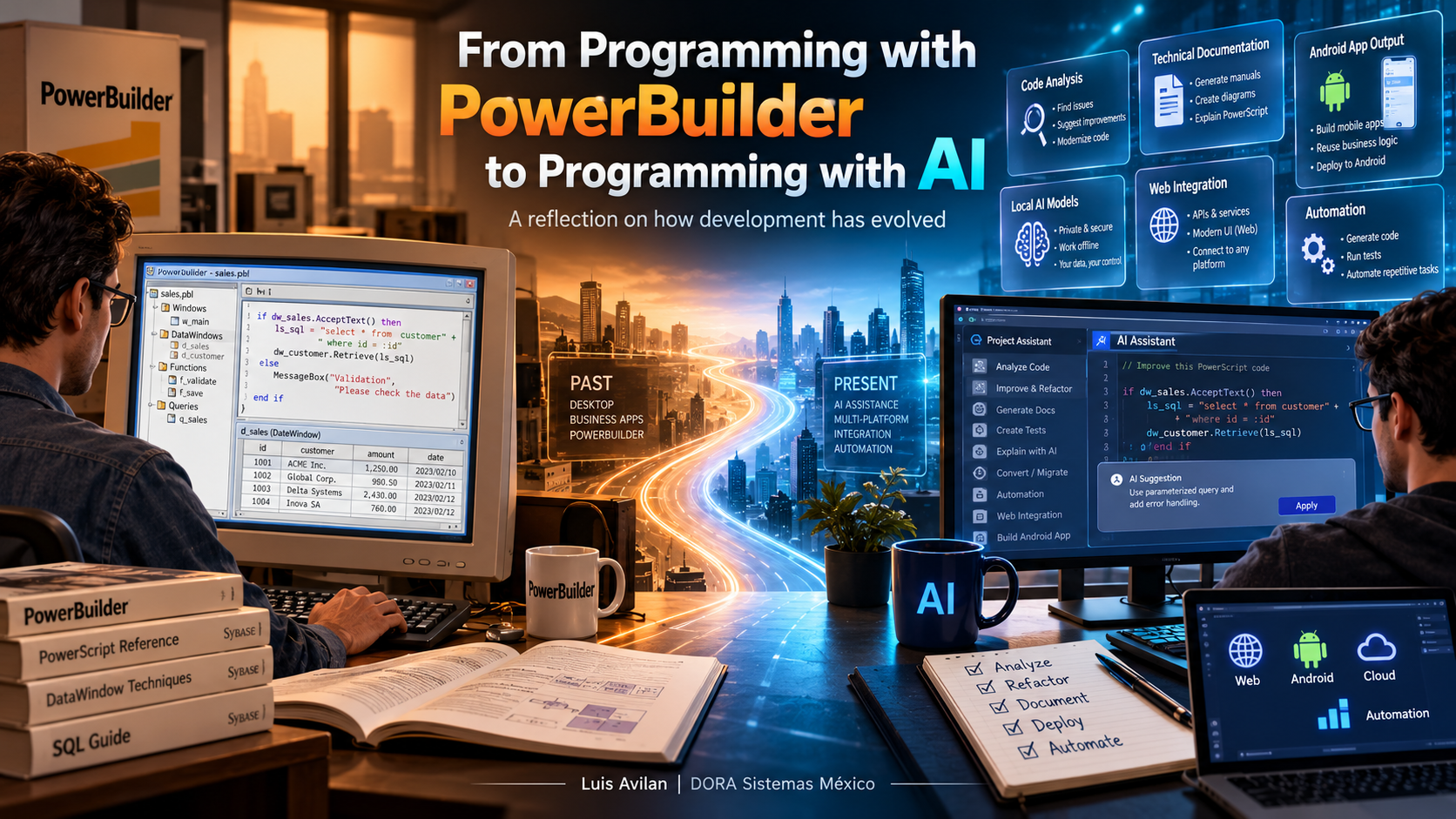
FROM PROGRAMMING WITH POWERBUILDER TO PROGRAMMING WITH AI: A REFLECTION ON OUR EVOLUTION
Who would have imagined, a few years ago, that we could talk to artificial intelligence and ask it to help us build an application in PowerBuilder?
For many years, those of us who develop with PowerBuilder learned to solve problems in a very particular way.
We spent hours in front of the IDE, writing PowerScript, designing windows, building DataWindows, debugging events, reviewing SQL statements, and searching for solutions to errors that sometimes took days to resolve.
I remember that way of working, when every new feature represented a challenge.
If we needed a DataWindow with groupings, subtotals, filters, calculated columns, and special formatting, we had to design it, code it, and test it step by step.
If we wanted to integrate an external service, we had to study its documentation, understand the protocols, build the requests, and process the responses.
And if we needed to document an application developed years earlier, the first challenge was often understanding what the code was actually doing.
That is how we learned to program. That is how we gained experience. And that is how we built enterprise systems that are still running today.
But something is changing.
ARTIFICIAL INTELLIGENCE HAS ARRIVED IN OUR DEVELOPMENT ENVIRONMENT
Today, we still use PowerBuilder, PowerScript, DataWindows, and SQL Server.
The technology we know has not disappeared.
What has changed is the way we interact with it.
Now we can explain what we need in natural language and work with an AI agent that helps us analyze code, propose solutions, build components, detect problems, and accelerate tasks that we previously performed manually.
And this is not simply an idea or a vision of the future.
We are already experiencing it through our own developments and demonstrations.
With our PowerBuilder AI Agent, we have explored a new way of working, where artificial intelligence does not simply answer questions but can collaborate with specialized tools to analyze applications and execute development processes.
We have worked on scenarios in which an agent analyzes DataWindows, their columns, properties, and SQL statements, proposes modifications, and uses PowerBuilder tools to obtain actual results and diagnostics.
We have also developed demonstrations showing how AI can participate in generating technical documentation for our applications, using the PowerScript code itself as a source of knowledge.
With PowerBuilder, Ollama, and local AI models, we have demonstrated that we can incorporate artificial intelligence capabilities without necessarily sending our enterprise data to external services.
With our AI No-Code Visual Builder, we explored how to combine PowerBuilder, Ollama, and WebView2 to create visual development experiences assisted by artificial intelligence.
And one of our most interesting experiments has been bringing PowerBuilder development into the Android ecosystem through PB Android Low-Code Transpiler Studios.
In that scenario, we worked with Android code generation, visual editing from PowerBuilder, emulator execution, and APK generation, using PowerServer as the bridge for database connectivity.
A few years ago, many of these scenarios would have seemed particularly complex.
Today, we are exploring them with tools that expand our capabilities as developers.
BEFORE, WE WROTE THE INSTRUCTIONS. NOW, WE ALSO DESIGN THE CONVERSATIONS.
Perhaps this is one of the most profound changes.
Before, when we needed to develop a feature, we mainly thought about the lines of code we had to write.
Today, we begin by thinking about the problem we want to solve, the context AI needs, the business rules involved, and how we will verify the result.
Before, we asked:
"How do I program this feature?"
Now, we also ask:
"How can I help my AI agent understand this feature, propose a solution, and help me validate it?"
This does not mean that programming is no longer important.
It means that technical knowledge has gained a new dimension.
Because artificial intelligence can generate code, but it does not necessarily understand all the particularities of an enterprise application that has been evolving for twenty years.
It does not automatically know our business rules, our transactions, the relationships between tables, or the consequences of modifying a critical process.
And that is exactly where the value of an experienced developer remains.
EXPERIENCE DOES NOT LOSE VALUE. IT BECOMES EVEN MORE IMPORTANT.
Sometimes, we hear that artificial intelligence will replace programmers.
After working on these experiments, my reflection is different.
AI can help us write code faster, but speed does not guarantee that a solution is correct.
We can generate a DataWindow in less time, but someone still needs to understand whether its calculations are correct.
We can automate a REST integration, but someone must validate security, error handling, and data integrity.
We can ask an AI agent to modify an application, but someone must decide whether that change respects the architecture and behavior of the system.
And something even more important: we must learn to question AI's own responses.
Because AI also makes mistakes.
It can invent functions that do not exist, misinterpret a business rule, or propose solutions that look correct but do not work in our version of PowerBuilder.
That is why our job no longer consists only of knowing how to write instructions.
It also involves knowing how to guide, review, validate, and make decisions.
POWERBUILDER HAS NOT BEEN LEFT IN THE PAST. THE WAY WE USE IT IS EVOLVING.
For years, we have heard comments about the age of PowerBuilder and whether it still has a place in modern software development.
However, our experiences are showing us something very interesting.
We can combine PowerBuilder with artificial intelligence, local models, specialized agents, REST services, modern web interfaces, PowerServer, and mobile technologies.
We do not need to abandon everything we have built in order to innovate.
We can leverage decades of enterprise knowledge and bring new capabilities to our existing applications.
For me, that represents a tremendous opportunity.
Because modernization does not always mean starting from scratch.
Sometimes, it means finding a new way to take advantage of what we already know how to do well.
A REFLECTION FOR THOSE OF US WHO HAVE BEEN PROGRAMMING FOR YEARS
When I look at how we used to develop applications and compare it with what we are doing now, I see one fundamental difference.
Before, much of our effort was focused on telling the computer exactly how to execute every instruction.
Today, we can devote more of that effort to explaining what we want to achieve, exploring alternatives, and verifying the results.
But there is something that has not changed.
We still need curiosity.
We still need patience.
We still need to understand systems.
And above all, we still need that ability to solve problems that has always defined a good programmer.
Artificial intelligence does not replace the years of experience accumulated in front of a screen.
It gives us an opportunity to multiply the value of that experience.
Perhaps the future of software development is not about writing more code, but about using our knowledge more effectively to build better solutions.
And after so many years working with PowerBuilder, there is something that especially excites me:
We are living through a new chapter in the history of a technology that many considered part of the past.
We are not leaving behind our history as developers.
We are using everything we have learned to write its next chapter.
Because before, we programmed with our hands, our experience, and our logic.
Today, we still do, but now we have artificial intelligence as a new development companion.
And the question is no longer whether AI will change the way we program.
The real question is:
Are we ready to evolve with it?
Luis Avilan
DORA Sistemas México
#PowerBuilder #ArtificialIntelligence #LuisAvilan #DoraSistemas #SoftwareDevelopment #Innovation #DigitalTransformation
Comments (0)